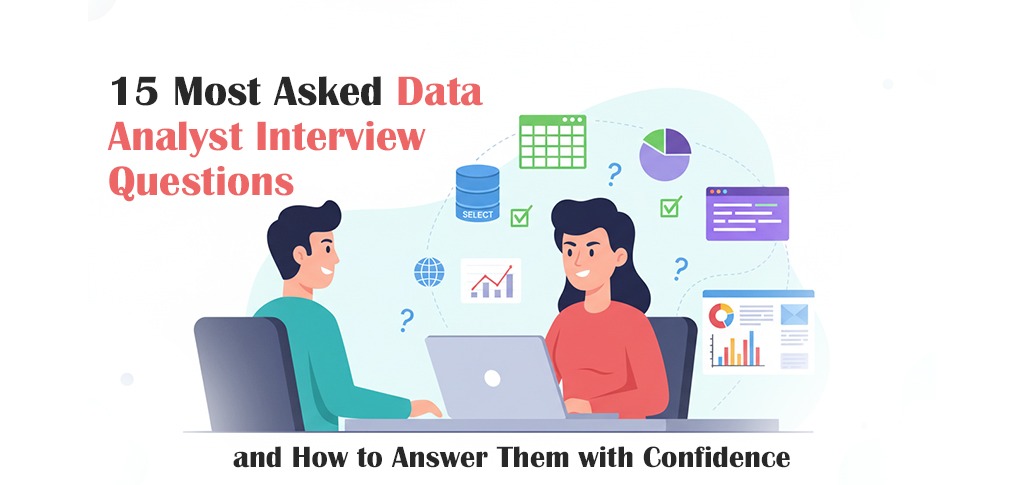
You want to become a data analyst, but are concerned about the types of questions you may be asked during your interview, once you know the types of questions that may be asked of you, your ability to respond confidently will become much easier! Many people experience anxiety during job interviews; however, with some planning, you can walk into your Data Analyst interview with calm confidence. A Data Analytics Professional Program in Kochi has provided you with the foundation to be successful and now you have the job knowledge to show your potential employer exactly how you can meet their needs.
This article will provide some frequently asked Data Analyst interview questions and insight as to what interviewers are searching for when asking these types of questions and provide you with insight on how to answer them effectively. Let’s get started!
1. What Are the Main Responsibilities of a Data Analyst?
Interviewers ask this question to see if you’re able to apply theoretical knowledge of a data analyst’s role in a real-life work environment.
A data analyst is a person who collects, cleans, and analyzes data to help make business decisions. The key part of the job is finding patterns, identifying problems, and presenting insights in a way that non-technical teams can easily understand.
A good answer should show how your work connects to business results, such as improving customer retention, optimizing campaigns, or identifying growth opportunities.
2. Which Data Analytics Tools Are You Familiar With?
This highlights your technical background and any support or training you might need.
Listing tools in a random way may work against your profile. Being able to clearly communicate which tools were actually used and in what capacity will better help your audience understand your capabilities For example, using SQL as a query tool, Excel as a reporting tool and then PowerBI or Tableau to create the dashboard would be beneficial.
The main point is not how many tools you know, but how confidently you can use them.
3. What Is Your Process for Working on a New Project?
This question is about your thinking process.
A good answer usually follows a clear flow:
- Understanding the problem
- Collecting relevant data
- Cleaning and preparing the data
- Analyzing and finding insights
- Presenting results
If possible, relate this to a real project. That makes your answer more believable and practical.
4. Share Your Most Challenging Data Analysis Project
The interviewers at this point in the process are looking for an indication of how well you handle challenges. Find a real-life example which did not turn out as expected. For example: If the data you were provided with was incomplete, inconsistent or of a size too large. Describe in detail the challenge you faced and how you resolved each issue.
Your answer does not have to be perfect, but you must communicate what you learned from your experience and what you would do differently should you face a similar situation again.
5. What’s the Largest Dataset you’ve Worked On?
The purpose of this question is to test how well you handle scale.
Please discuss the size, type of data and complexity of your data. If you’re a fresher, you can mention projects from courses or bootcamps.
Be honest. Do not exaggerate numbers. Interviewers typically ask for follow-up questions.
6. Which Statistical Methods Have You Used?
Most entry-level jobs need a basic understanding of different statistical methods. It’s important to have a strong understanding of these methods.
Share how you have used statistical methods to reach business goals. Mention the methods you have used and the insights they provided for the business.
7. How Do You Handle Data Inconsistencies?
Companies need to know that you can handle data inconsistencies so you can clean and process data quickly.
It is best to start your response with an example of how you have dealt with a problem involving a database and then describe your thinking, analytical ability, and attention to detail in the solution of that issue.
8. Difference Between Data Mining and Data Analysis
This question helps them test your knowledge of analytical concepts, so give a proper explanation and comparison between them.
Start by outlining the ideas and their significance to the company. Compare these two and point out the benefits and drawbacks of each. Please be aware that depending on the interview, the concepts may change
9. What Is Data Cleansing and How Do You Do It?
Data cleansing is a critical step before analysis.
It involves:
- Removing duplicates
- Handling missing values
- Fixing incorrect or inconsistent data
- Dealing with outliers
A clean dataset leads to more accurate insights. That’s the key point to highlight.
10. Explain the KNN Imputation Method
You don’t need to overcomplicate this.
KNN imputation is used to fill missing values based on similar data points. It finds the nearest neighbors and uses their values to estimate the missing data.
Keep your explanation simple and clear. That matters more than sounding technical.
11. Describe Time Series Analysis
Time series analysis is used when data is collected over time.
It helps identify trends, patterns, and seasonality. For example, analyzing monthly sales or website traffic over a year.
If you’ve used it before, mention where and how it helped.
12. Why Would You Like to Work With Us as a Data Analyst?
This is less about data and more about intent.
Show that you’ve done your homework. Talk about the company, its work, and how your skills align with their goals.
Avoid generic answers. Make it specific.
13. If You Ever Missed a Deadline, How Did You Handle It?
They want to understand how you deal with pressure.
Be honest. Explain what caused the delay, how you communicated it, and what you did to fix the situation.
Also mention what you changed afterward to avoid repeating the same mistake.
14. How Do You Check if a Data Model Is Performing Well?
This question evaluates your analytical thinking.
You can talk about metrics like accuracy, precision, recall, or error rates depending on the model.
Also explain how you validate results and what steps you take if performance is not satisfactory.
15. How Have You Used Excel for Data Analysis?
Excel is still widely used, so this question is common.
Talk about:
- Pivot tables
- Data cleaning
- Basic formulas
- Charts and reports
If possible, mention a real use case where Excel helped you complete a task efficiently.
Final Thoughts
Preparing for a data analyst interview is not about memorizing perfect answers. It’s about understanding how to think with data and explain your approach clearly.
Focus on building strong fundamentals, practicing real-world problems, and learning how to communicate your insights in a simple and structured way. If you’re learning from a Data Science Institute in Kochi, make sure the training goes beyond theory and includes practical exposure and interview preparation.
Choosing the right place to learn also makes a difference. RP2 Kochi, we focus not just on teaching, but on preparing you for real career opportunities.