Many freshers and graduates believe that entering the IT industry requires programming skills. While coding is important for software development, not every IT job requires coding. Technology companies also need professionals in data analysis, software testing, business analysis, design, IT support, digital marketing, and project management.
If you are a graduate who wants to build a career in technology without becoming a programmer, there are several non-coding IT careers for freshers worth exploring.
What Are Non-Coding IT Careers?
Non-coding IT jobs are technology-related roles where programming is not the primary responsibility. These roles may still require technical knowledge, software tools, analytical thinking, and an understanding of technology.
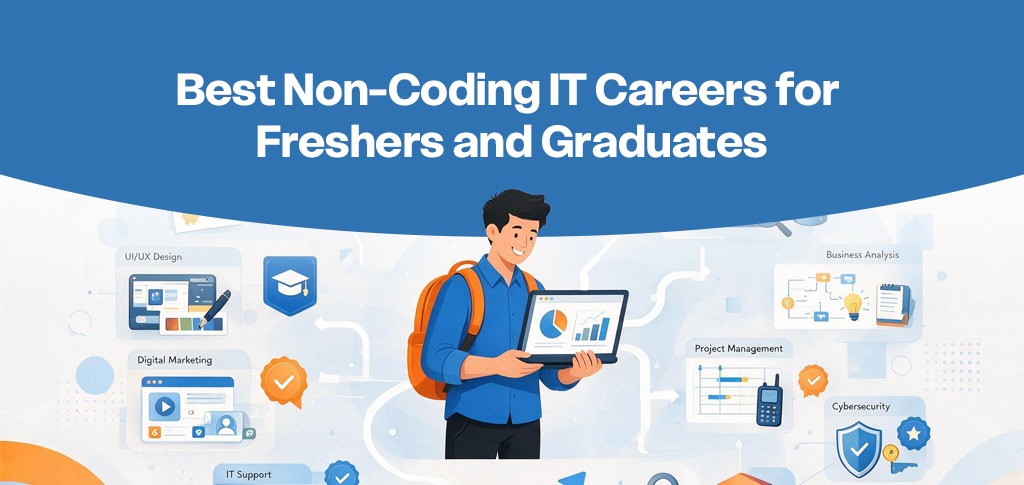
Some of the best non-coding IT careers for freshers and graduates include Data Analyst, Business Analyst, Software Tester, UI/UX Designer, IT Support Specialist, Digital Marketing Specialist, Technical Writer, and Project Coordinator.
1. Data Analyst
Data Analysts collect, clean, analyze, and visualize data to help businesses make informed decisions.
Skills: Excel, Power BI, SQL, statistics, and data visualization.
This career is suitable for graduates who enjoy numbers, logical thinking, and identifying patterns in data.
2. Business Analyst
Business Analysts understand business requirements and work with teams to improve processes and develop suitable technology solutions.
Skills: Requirement gathering, documentation, Excel, communication, process mapping, and basic analytics.
This is a good option for graduates who enjoy problem-solving and communicating with different teams.
3. Software Tester
Software Testers check applications and websites to identify bugs and ensure that software works as expected.
Manual testing can be a good starting point without requiring programming knowledge.
Skills: Manual testing, test cases, bug reporting, Jira, Agile, and software testing fundamentals.
4. UI/UX Designer
UI/UX Designers focus on creating user-friendly and visually effective digital experiences.
Skills: Figma, wireframing, prototyping, user research, and design principles.
This career can suit creative graduates interested in technology and design.
5. IT Support Specialist
IT Support professionals help users troubleshoot hardware, software, operating system, account, and basic network issues.
Skills: Windows, hardware fundamentals, networking basics, troubleshooting, and ticketing systems.
This can be a suitable entry-level IT career for graduates who enjoy solving technical problems.
6. Digital Marketing Specialist
Digital marketing combines technology, creativity, and business. Professionals work with SEO, paid advertising, social media, analytics, and content platforms.
Skills: SEO, Google Ads, Meta Ads, Google Analytics, content marketing, and reporting.
It is suitable for graduates interested in marketing and technology without wanting to pursue programming.
7. Technical Writer
Technical Writers create user guides, product documentation, help articles, and other technical content.
Skills: Writing, research, documentation, communication, and basic technical understanding.
This role is particularly suitable for graduates with strong communication and writing abilities.
8. IT Project Coordinator
IT Project Coordinators help teams manage timelines, documentation, meetings, tasks, and project communication.
Skills: Project management, Excel, communication, documentation, Jira, and Agile fundamentals.
This can be a good choice for organized graduates who enjoy planning and coordination.
Which Non-Coding IT Career Is Right for You?
Your interests can help determine the right career path:
- Numbers and analysis: Data Analyst
- Business and problem-solving: Business Analyst
- Finding software issues: Software Tester
- Creativity and design: UI/UX Designer
- Troubleshooting: IT Support
- Marketing and communication: Digital Marketing
- Writing: Technical Writer
- Planning and coordination: Project Coordinator
How Can Fresher’s Start a Non-Coding IT Career?
Start by choosing one career instead of trying to learn everything.
Follow a simple path:
Choose a career → Learn relevant skills → Practice with projects → Build a portfolio → Prepare for interviews → Apply for jobs
Practical projects are especially valuable because they demonstrate that you can apply what you have learned to real-world situations.
Final Thoughts
A career in IT does not begin and end with programming. Freshers and graduates can explore opportunities in data analytics, business analysis, software testing, UI/UX, IT support, digital marketing, and project coordination.
The key is to choose a career that matches your strengths, develop practical skills, and gain hands-on experience.
You do not need to become a programmer to build a career in technology. You need the right skills, practical experience, and a willingness to keep learning.
Frequently Asked Questions (FAQs)
Can I get an IT job without coding?
Yes. Roles such as Data Analyst, Business Analyst, Manual Tester, UI/UX Designer, IT Support, and Project Coordinator may not require programming as their primary skill.
Which is the best non-coding IT job for freshers?
There is no single best option. The right career depends on your interests, educational background, and strengths.
Can B.Com or BBA graduates enter IT?
Yes. Business and commerce graduates can explore careers such as Business Analyst, Data Analyst, Digital Marketing Specialist, and Project Coordinator.
Do non-coding IT jobs have career growth?
Yes. Many roles offer progression from entry-level positions to senior and specialist roles as you gain experience and develop additional skills.