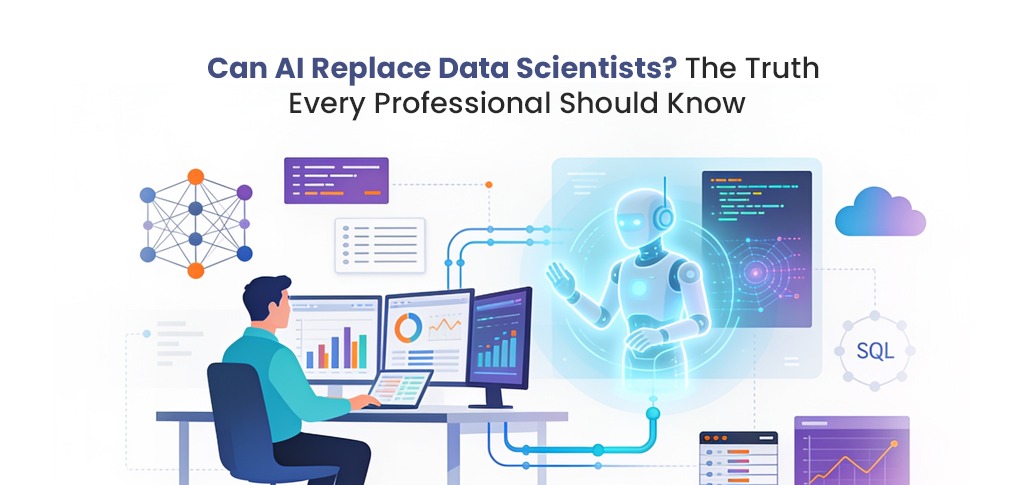
Artificial Intelligence has moved well past the hype stage. It writes code, builds models, cleans data, and generates reports often faster than a human can. So it’s natural that one question keeps coming up in career forums, LinkedIn debates, and search engines alike: Can AI replace data scientists?
This isn’t just a technical question. For students considering a Data Science Course in Kochi and professionals already in the field, it’s a decision-making question. Getting a clear, honest answer matters more than a reassuring one.
What Does a Data Scientist Actually Do?
To answer whether AI can replace the role, it helps to first be clear on what the role really involves because it’s broader than most people assume.
On a typical project, a data scientist:
- Works with stakeholders to understand what problem actually needs solving
- Sources data from multiple, often inconsistent systems
- Cleans and prepares that data before any modeling begins
- Chooses the right technique for the problem, not just the most popular one
- Tests whether the model’s results are actually reliable
- Explains what the results mean to people who don’t work with data every day
Notice how much of this list has nothing to do with writing code. That’s the part most conversations about AI replacement tend to skip.
Why People Assume AI Will Take Over
The concern isn’t irrational. AI tools genuinely can:
- Clean and preprocess raw data automatically
- Recommend which model to use for a given dataset
- Tune model parameters without manual trial and error
- Generate dashboards and written summaries from results
Five years ago, most tasks required a trained analyst to spend hours on manual work. Now, these tasks can be completed in minutes. This speed is why AI will take over the role of data scientists. The parts of the job that are visible and repetitive got automated first, and that is what people notice.
Where AI Genuinely Helps
AI is at its best when a task is repetitive, and the rules are clear. In data science that means AI is genuinely useful for:
- Processing large datasets faster than any human team could
- Spotting patterns across huge volumes of data
- Handling the repetitive middle steps of a project
- Reducing errors that come from manual, repetitive work
Used well, AI doesn’t compete with a data scientist; it clears the busywork off their desk so they can spend time on the parts of the job that actually require judgment.
Where AI Still Falls Short
This is the part that gets left out of most “AI will replace your job” headlines. AI still cannot:
- Understand a business problem without a human explaining it first
- Know which question to ask when the data itself is incomplete or messy
- Make ethical calls in situations where the right answer depends on context, not just accuracy
- Judge whether a technically correct result actually makes business sense
- Persuade a room full of non-technical stakeholders to act on a finding
A model can tell you what the data shows. It can’t reliably tell you whyitmatters or whattodoaboutit. That gap is still entirely human territory.
So Who’s Actually at Risk?
Not data scientists as a group, but a specific kind of data scientist.
AI is likely to take over simple tasks that require little judgment. If someone only knows how to run existing processes without understanding how they work, that puts them in a vulnerable position.
On the other hand, professionals who:
- Understand the statistics and logic behind the models they use
- Can connect a technical result back to a business decision
- Are comfortable working across real datasets, not just clean training data
- Keep learning as tools change
Are becoming more valuable, not less. In India, job listings for data scientists have increased by 29%. Future of Data Science & Data Analytics in India, demonstrating the accelerating demand across industries. Recent studies have also indicated that the top jobs in India will be Data Scientists, Data Analysts, and Machine Learning Engineers. Future Scope of Data Science in India: Demand and Trends.
The Role Is Changing, Not Disappearing
Data science five years from now won’t look identical to data science today. Modern data scientists are increasingly expected to:
- Work alongside AI tools rather than instead of them
- Spend less time on manual prep work and more on interpretation
- Take on more strategic, decision-facing responsibilities
- Move faster from raw data to a usable business recommendation
If anything, this shift raises the bar for what a good data scientist looks like; it doesn’t lower the demand for one.
Building a Career AI Can’t Easily Touch
For anyone starting out, or already in the field and wondering how to stay relevant, the fundamentals haven’t actually changed that much:
- Get genuinely solid at statistics, Python, and SQL not just comfortable enough to get by
- Learn how AI and machine learning tools actually work, not just how to click through them
- Build real experience with messy, real-world data and cloud platforms
- Practice explaining technical findings to people who aren’t technical
- Keep learning; this field moves fast enough that standing still is its own risk
Formal, hands-on training tends to matter more here than self-study alone, simply because real project exposure is where most of these skills actually get built.
Final Thoughts
AI is not going to take over data scientists’ jobs. Instead, it will handle the repetitive tasks, which is good for data scientists. This means they can spend less time on manual work and more time on tasks that need human thinking.
The people who should be worried are not data scientists in general. Those who should be concerned are the ones who only know how to use the tools but do not understand how they work. For everyone else, data science is still a stable, well-paying, and future-ready career choice. If you’re planning to build a career in this field, choosing a Data Science Training Institute in Kochi like RP2 can help you gain the practical skills, industry exposure, and problem-solving mindset that employer’s value and AI cannot replace.