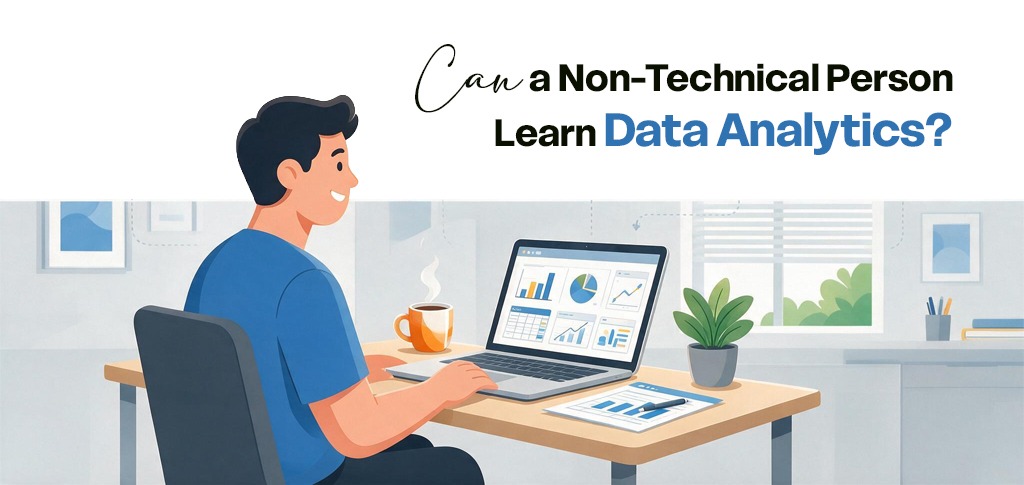
Yes, a non-technical person can learn data analytics. You do not need a computer science degree, advanced mathematics skills, or years of programming experience to get started. With a structured learning path, practical training, and consistent practice, people from different educational backgrounds can develop the skills needed to work with data.
Why Do People Think Data Analytics Is Technical?
Data analytics involves terms such as SQL, Python, databases, Power BI, statistics, and data visualization. For someone without a technical background, these terms can initially seem difficult.
However, data analytics is not only about coding. It involves understanding data, identifying patterns, solving problems, and communicating insights that can help businesses make better decisions.
People from commerce, finance, marketing, business, management, and other non-technical backgrounds can use their existing industry knowledge while developing analytical skills.
What Skills Does a Beginner Need?
You do not need to learn everything at once. Start with the fundamentals and gradually build your skills.
Excel
Excel is one of the easiest places to begin. Learn formulas, sorting and filtering, pivot tables, charts, and basic data cleaning.
SQL
SQL is used to retrieve and analyze data stored in databases. Beginners can start with simple queries and gradually learn filtering, grouping, joins, and calculations.
Power BI
Power BI helps turn data into interactive reports and dashboards. It is useful for presenting trends and insights in an easy-to-understand format.
Basic Statistics
You do not need advanced mathematics. Understanding averages, percentages, ratios, distributions, and basic statistical concepts is enough to begin.
Analytical Thinking
One of the most important skills is knowing how to ask the right questions. Instead of simply reporting that sales decreased, an analyst should investigate why they decreased and what the business can do about it.
How Can a Non-Technical Person Start Learning Data Analytics?
A structured approach can make the learning process much easier.
Learn the fundamentals. Understand how businesses collect, clean, analyze, and use data.
Learn Excel. Build confidence by working with spreadsheets and simple datasets.
Learn SQL. Understand how to retrieve and analyze information from databases.
Learn Power BI. Create dashboards and visualize business information.
Work on projects. Analyze real-world datasets related to sales, marketing, finance, customers, or business operations.
Step 6: Build a portfolio. Showcase your projects, analysis process, insights, and recommendations.
Do You Need Python?
Python is useful for advanced analytics, automation, data science, and working with larger datasets. However, you do not need to learn Python before starting your data analytics journey.
A beginner can start with:
Excel → SQL → Power BI → Python
This allows you to build a strong foundation before moving into more advanced areas.
Common Misconceptions About Data Analytics
“I need to be good at mathematics.”
Advanced mathematics is not required for most beginner-level analytics work.
“I need programming experience.”
You can start learning analytics without previous coding experience.
“Only computer science graduates can become data analysts.”
People from many educational backgrounds can develop data analytics skills.
“I need to master every tool.”
It is better to understand a few important tools well than to learn many tools superficially.
Final Thoughts
A non-technical background should not stop you from learning data analytics. You do not need to become a programmer before you begin. Start with the fundamentals, learn Excel, gradually move to SQL and Power BI, and gain practical experience through real-world projects with RP2.
The most important part is not how technical your background is. It is your willingness to learn, practice, ask questions, and use data to solve real problems. With the right Data Analytics Course in Kochi, practical training, and consistent effort, you can build the skills needed to pursue a career in analytics.
With RP2’s structured Data Analytics Training in Kochi and industry-focused learning approach, data analytics can be an achievable career option for beginners from a wide range of backgrounds.
Frequently Asked Questions (FAQs)
Can a commerce graduate learn data analytics?
Yes. A commerce background can be useful for understanding financial, sales, and business data.
Is data analytics difficult for beginners?
It can feel challenging initially, but learning one concept and tool at a time makes the process more manageable.
How long does it take to learn data analytics?
There is no fixed timeline. With consistent practice, a beginner can build a solid foundation within a few months.
Can I learn data analytics while working?
Yes. Many people learn part-time by following a structured schedule and practicing regularly.