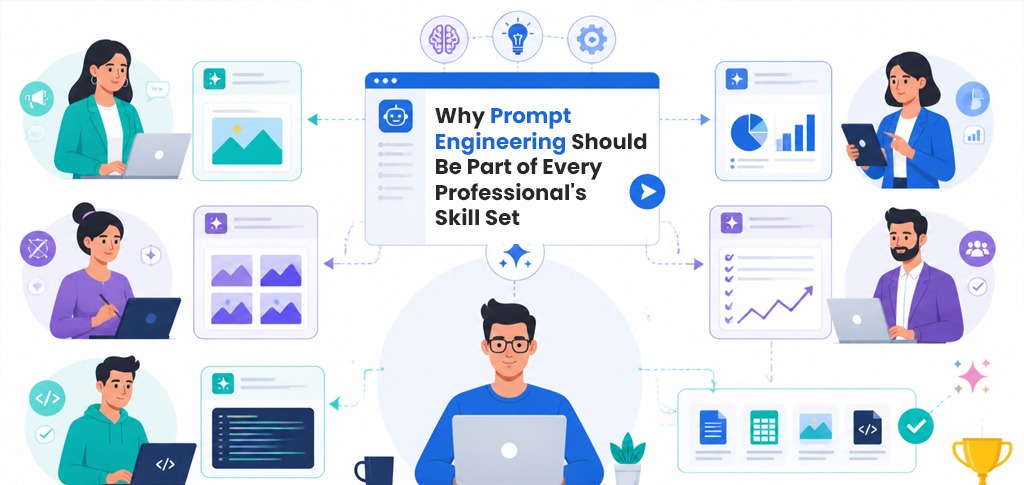
A few years ago, knowing how to use a spreadsheet was considered a bonus skill. Today, it is a basic expectation in almost every workplace. Prompt engineering is heading in the same direction and faster than most professionals realise.
You do not have to work in technology to benefit from it. You do not need to understand how AI models are built. You just need to know how to use them well, and that is exactly what prompt engineering teaches you.
Here is why prompt engineering is quickly becoming a skill every working professional needs, regardless of their field.
What Is Prompt Engineering?
Prompt engineering is the skill of writing clear instructions that guide AI tools to produce the output you actually want. Tools like ChatGPT, Claude, and Gemini are powerful, but they rely entirely on the quality of the instructions you give them.
A vague instruction gives a vague result. A well-written prompt gives you something genuinely useful: a professional document, a clear summary, a well-researched answer, or a complete first draft in minutes instead of hours.
Why Is Prompt Engineering Becoming So Important?
AI tools are no longer optional extras. They are being built into email platforms, document editors, search engines, customer service systems, and workplace software of every kind. Most professionals will interact with AI tools in some form every working day.
The professionals who know how to direct those tools effectively will work faster, produce better outputs, and be more valuable to their organisations than those who do not. Prompt engineering is the skill that makes the difference.
6 Reasons Prompt Engineering Should Be Part of Your Skill Set
1. It Makes You Significantly More Productive
AI tools can handle a wide range of time-consuming tasks, such as drafting documents, summarising research, generating ideas, answering questions, and analysing information. But only if you know how to direct them properly.
A professional who can write effective prompts gets genuinely useful AI outputs in minutes instead of hours. A professional who cannot get vague, generic responses that need to be heavily rewritten. Prompt engineering is, at its core, a productivity multiplier and in any profession, the ability to do more in less time is an advantage that compounds over time.
2. It Strengthens Your Existing Expertise
Prompt engineering does not replace your professional knowledge; it amplifies it. A doctor who understands how to prompt AI for medical research summaries gets better research outputs because they know what to ask and how to evaluate the answer. A lawyer who can prompt AI to draft contract clauses saves hours on routine work while applying their own judgment to refine the result.
Whatever your field, your existing expertise makes your prompts better. And better prompts make your expertise more productive. The two reinforce each other.
3. It Is a Skill That Transfers Across Every Tool and Platform
The specific AI tools available today will evolve. New models will emerge. Platforms will change. But the underlying skill of knowing how to communicate clearly with an AI model, how to give context, set expectations, specify format, and refine outputs transfers across all of them.
Learning prompt engineering is not learning one tool. It is learning a way of thinking and communicating that will remain relevant regardless of which AI tools your workplace adopts in the future.
4. It Opens Up New Career Opportunities
Prompt engineering skills are now listed as desirable in job descriptions across a wide range of industries. Organisations are looking for marketing professionals, educators, healthcare workers, HR managers, and business analysts who can work effectively with AI and demonstrate the skill sets that set them apart from candidates who cannot.
Beyond job applications, prompt engineering opens up freelance opportunities, consulting possibilities, and the ability to build AI-powered tools and content for clients. It is a skill with a career ceiling that keeps rising.
5. It Reduces the Frustration Most People Feel With AI
One of the most common experiences people have with AI tools is disappointment. They try it once or twice, get underwhelming results, and conclude that AI is overhyped. Almost always, the problem is not the AI; it is the prompt.
Learning prompt engineering transforms that experience. When you understand how to frame instructions, provide context, assign roles, and specify outputs, AI tools stop feeling unreliable and start feeling genuinely powerful. The frustration disappears because you know how to get what you need.
6. It Is One of the Easiest High-Value Skills to Learn
Unlike most skills that command a premium in the job market, such as data science, software engineering, and financial modelling, prompt engineering has no significant technical barrier to entry. You do not need a degree. You do not need prior experience with AI. You need clear thinking, good communication, and consistent practice.
That accessibility, combined with the demand for the skill, makes prompt engineering one of the most efficient professional investments you can make right now.
How Do You Start Learning Prompt Engineering?
Getting started with prompt engineering is easier than most people expect. Here is a simple path:
- Start using AI tools today – Open ChatGPT, Claude, or Gemini and begin using them for real tasks in your daily work. Notice what works and what does not.
- Learn the core techniques – A few foundational techniques, giving context, specifying format, assigning a role to the AI, and breaking tasks into steps, will immediately improve your results.
- Apply it to your actual work – Use AI to help with a report, a presentation, or a difficult email you are genuinely working on. Real tasks produce real learning.
- Invest in structured learning – Self-practice is valuable, but structured training gets you there faster. The RP2 3-Month Prompt Engineering Professional Course provides a clear, practical curriculum that takes you from beginner to job-ready practitioner, covering real professional use cases, not just theory.
- Make it a daily habit – Prompt engineering improves fastest with consistent use. The more you use it, the better you get.
Final Thoughts
Prompt engineering is the skill that separates professionals who use AI effectively from those who find it frustrating. It is accessible to anyone, builds directly on what you already know, and delivers immediate results across professions.
Whether you develop it through daily practice or through a structured programme like the AI Prompt Engineering Professional Course in Bangalore, the most important thing is to start. In the workplace taking shape right now, knowing how to use AI well is not a nice-to-have; it is what sets you apart.
Frequently Asked Questions (FAQs)
Do I need to know coding to learn prompt engineering?
No, prompt engineering requires no coding or programming knowledge whatsoever. It is a communication and critical thinking skill. You write instructions in plain, everyday language, and the AI responds. If you can write a clear email, you already have the basic ability needed to start.
How long does it take to learn prompt engineering?
The basics of prompt engineering can be learned within a few days of consistent practice. Becoming genuinely skilled and able to write effective prompts for complex professional tasks typically takes a few weeks to a few months. A structured course like the Prompt Engineering Professional Course is designed to build this skill systematically, so you develop it completely rather than through guesswork.
Can a non-technical professional get a job in prompt engineering?
Yes, many organisations hiring for prompt engineering roles prioritise domain expertise and communication skills over technical knowledge. Teachers, marketers, writers, healthcare workers, and HR professionals are being hired for AI-related roles without any programming background. Your professional expertise is an asset, prompt engineering is the skill that unlocks it.